| Introduction This brief provides an objective analysis and discusses a better way forward to conserve that part of Amazonia that is under the direct governance of the Brazilian government in order to protect its biodiversity, reduce poverty amongst its indigenous peoples and provide a better managed agriculture and other relevant industries. It provides a path to the re-engagement of the Brazilian people to the Amazonian biodiversity and how more effective use of the ecosystem services is provided by this biodiversity, for food, health |
| benefits, poverty reduction and an opportunity to become a global leader in the conservation of the world’s rainforests. It will highlight the responsibilities of environmental citizenship not only as a government but also as citizens. This brief starts by describing, in more detail, the main purpose of this document followed by an in-depth analysis of the issues, providing arguments for and evidence to support the main drive and focus of the topics raised. A concise summary is then provided followed by recommendations and action points. |
Main purpose
Brazil contains the largest extent of rainforest cover within the South American Amazonia region. It is now recognised that rainforests are critically important to humanity and are estimated to contain over 50% of the planets plant and animal species (WWF, Living Amazon Report, 2016) and this report has been written to advise the Brazilian Agribusiness and Environment ministers of why the rainforest is so important. It will discuss how deforestation destroys the habitat, for this biodiversity, and a better way forward which not only will conserve the rainforest but will also reduce poverty amongst the indigenous peoples, increase employment, encourage co-partnership and trans-boundary working.
The report will demonstrate how the above will forge economic development in a sustainable way and provide new and increased income streams via the appreciation, globally, of the importance of the services that are obtained from rainforests (Ecosystem services). These include storing billions of tons of carbon, buffering against flood and drought, soil stabilization, providing habitats to wildlife, food and medicine provision, recreation, tourism, freshwater management and education.
Marketing these services, both internally and globally, would raise the possibility of further income streams via payment for ecosystem services, carbon trading, trading of non-wood products and further income via Reducing Emissions from Deforestation Degradation scheme (REDD+). Brazil could become a world leader in the sustainable development of rainforests.
Analysis
The Amazonian rainforest is one of the richest regions, in the world, for its sheer diversity of wildlife species (biodiversity). These include approximately 40,000 plant species, 5,600 fish species, 1,300 bird species, 1,000 amphibian species and 4,000 reptilian species (Butler, 2019). This richness is due to the specific habitats provided by the rainforest including other important services (ecosystem services) such as food, medicine etc. which have been highlighted within the previous section. Brazil has governance of 59.17% of the Amazonian biome (WWF, Living Amazon Report 2016).
Whilst it is understood that its natural resources are a source of income, as is deforestation for agricultural expansion, it has been done at the cost of destroying the very habitats that sustain its biodiversity and other ecosystem services. Whilst deforestation rates reduced after 2008 the rate has seen a year on year increase since 2013. For the 12-month period August 2017 to July 2018 an increase of 13.7% has been recorded as compared with the previous 12 months see Fig 1 below (REDD-monitor.org, 2018).
Graphic displaying annual deforestation rates within the Brazilian Amazonian since 2002.
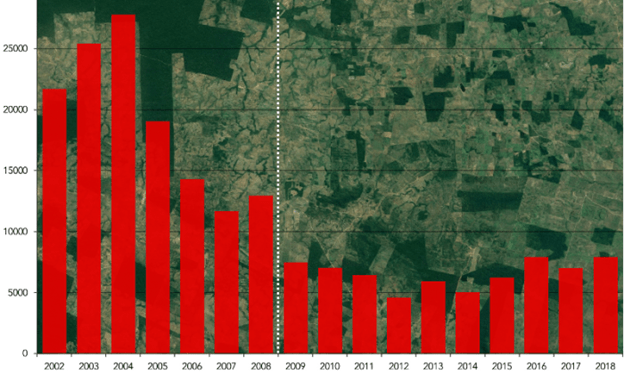
FIG 1 Graphic displaying deforestation rates between 2002 and 2018. REDD-monitor.org,2018
Due to election promises it is expected that deforestation rates will increase dramatically under the new presidency of Jair Bolsonaro in favour of agriculture, mining and logging. Not only does this ignore the United Nations Sustainable Development Goals (SDGs) agreed by UN leaders , in 2015, but also ignores the global appreciation of sustainable forest management as demonstrated by afforestation or forest rehabilitative programmes as launched by China, Egypt, India, Iran, Kuwait, Mexico, Morocco and Tunisia (Greenfacts, 2016).
Mexico has made great strides in democratising its forest governance. More than 70% of the country’s forests are controlled by 35,000 indigenous and rural communities. They are running successful forest enterprises while checking deforestation that was once rampant (Shrivastava, 2015).
For the past two decades Mexico has been implementing its forest related policies and programmes, keeping communities as the main stakeholder. The Mexican government has gone from ‘top down’ governance to facilitator of community forestry. Whilst mistakes were made during the initial phases it is possible to learn from those to avoid the same pitfalls. For this to succeed local indigenous groups have to be involved from the start, strengthening rights of tenure and provide technical and financial support. Apart from logging, communities need to be trained in other businesses such as ecotourism, spring water bottling and other non-wood products.
Strict regulations still need to be applied to stop illegal logging and any legal timber harvesting has to be approved and comply with an approved management plan. CFE’s should be allowed to run timber mills employing local peoples and be allowed to plough back into the community a percentage of the profits to support provision of food and social welfare. By increasing employment opportunities Mexico has demonstrated that migration from rural areas has slowed and locally run businesses are supporting their local population, reducing poverty and providing training in new opportunities to profit, sustainably, from ecosystem services in conjunction with co-management with private companies. To increase the value of sustainably produced products the Forest Stewardship Council (FSC) should take an active part in providing sustainable certification and assist in enforcing the forestry management plans. Several studies show that deforestation in community managed forests reduces and, by planting native tree species in logged areas, maintains the biodiversity of the forests (Shrivastava, 2015).
Brazil already receives payments under REDD+ but is in danger of losing this if deforestation increases. However, larger payments may be gained by demonstrating proper forestry management and decreases in deforestation. Also increased funding could be obtained via the Forest Carbon Partnership facility by selling carbon credits where REDD+ schemes have been approved and verified. The intention being to fund forest conservation and management schemes (FCP, 2017).
To assist in protecting the forests current agricultural land should be using modern agricultural intensification methods and make ensuring investment from the private sector rather than clearing forests. However, once agricultural land has been degraded afforestation projects should be promoted to restore ecological balance in these degraded areas.
The Shandong area of China has demonstrated that afforestation of degraded areas could generate incomes through allowing local communities to plant commercial tree crops such as fruit and nuts which also increases employment and contributes to the sequestration of CO2, increasing income via carbon trading. Financial support for such projects can be gained from the World Bank in the form of loans from the International Bank for Reconstruction and Development. The Shandong project increased forest cover, reduced soil erosion and improved the local environment and its biodiversity (World Bank, 2017).
Brazil is one of eight countries that share governance of the Amazonia biome. Biodiversity transcends national boundaries, and to ensure continuity of deforestation reduction and sustainable development schemes, transboundary agreements should be sought to ensure a robust Amazon wide conservation strategy is put in place.
Summary
Rainforests provide a vital service to mankind. They provide food, shelter, medicines and are home to more species of plants and animals than any other terrestrial ecosystem on the planet. Rainforests also play an important part in the water cycle, protect against flood, drought, soil erosion and CO2 sequestration from the atmosphere.
Deforestation and unsustainable use of the Amazon’s natural resources is gradually destroying this biome. Brazil has governance over 57.15% of this biome and, under the new presidency has an opportunity to lead the world in reversing the policies and development that are adding to this destruction.
By involving local indigenous communities at every level to assist in the production of forest management schemes and providing expertise and training has the potential to provide employment for local communities running co-managed operations in sustainable logging, water bottling and other non-wood products and development of sustainable livelihood opportunities in afforestation schemes growing cash earning crops such as nuts and fruits on agricultural degraded land.
This reduces poverty and reduces the drain on the welfare state and provides income via increased tax receipts. Globally, an increase in incentive payments under the REDD+ scheme and carbon trading could also be available increasing net receipts to the government.
Recommendations
It is impossible in a report of this size to provide an exhaustive set of solutions to the problems of deforestation within the Amazonia biome. However, the following recommendations are believed to provide a way forward :
Involve local communities at all levels of management by economic development of the Amazonian biome.
Allow communities to form community forest enterprises (CFE) in joint management with government and private enterprise.
Supply expertise and training to support CFEs in in the production of non-wood products.
Allow local communities to take tenure of over-used agricultural land to plant saleable crops, such as Brazil nuts and rubber, as part of afforestation schemes.
Involve the Forestry Stewardship Council to assist controlling the use of natural resources in a sustainable way.
Apply strict sanctions on companies using illegally logged resources and enforce them.
Consult other Amazonia nations to forge agreements that support and cement transboundary working.
Copyright M.Taylor 2019
References
Butler, R, (2019) “Animals in the Amazon Rainforest.” Mongabay. Accessed May 9, 2019. https://rainforests.mongabay.com/amazon/amazon_wildlife.html.
Butler, R, (2019) “Rainforests.” Mongabay.com. Accessed April 27, 2019. https://rainforests.mongabay.com/.
“Deforestation in Brazil’s Amazon Hits Highest Rate for Ten Years, According to Brazil’s Government. It’s Way Worse According to Global Forest Watch | REDD-Monitor.” Accessed May 6, 2019. https://redd-monitor.org/2018/11/28/deforestation-in-brazils-amazon-hits-highest-rate-for-ten-years-according-to-brazils-government-its-way-worse-according-to-global-forest-watch/.
“Forests & Agriculture Land Use: 1. 1. The Link between Forests and Food Security.” Accessed May 13, 2019. https://www.greenfacts.org/en/forests-agriculture-land-use/l-2/index.htm.
“Living Amazon Report 2016 | WWF.” Accessed April 13, 2019. http://wwf.panda.org/?270437/Living-Amazon-Report-2016.
Shrivastava, K. 2015 “Forestry, the Mexican Way.” Accessed May 18, 2019. https://www.downtoearth.org.in/coverage/forests/forestry-the-mexican-way-48227.
“The Carbon Fund | The Forest Carbon Partnership Facility.” Accessed May 19, 2019. https://www.forestcarbonpartnership.org/carbon-fund-0.
| The Curse of Deforestation |
 The Inevitable Climate Change