I believe we all understand that the Earth’s orbit around our Sun is not a neat and tidy one. An astronomer by the name of Milutin Milankovich explained how the Earth’s various movements affected the energy received from the sun over thousands of years.
As we derive most, if not all, our energy from the Sun it is logical that the position and distance, of the Sun, in relation to the Earth’s surface will have an effect on global climate.
The image below illustrates the 3 main cycles identified by Mr Milankovich.
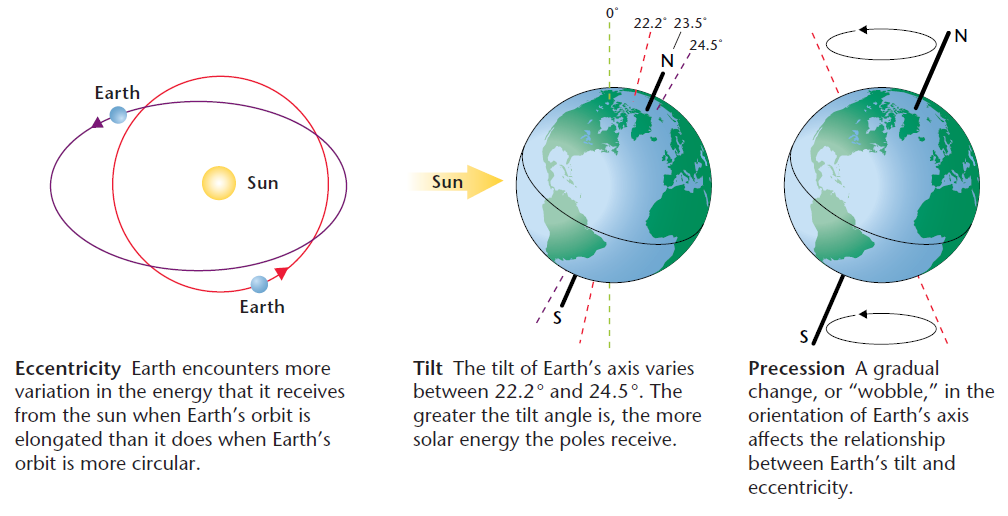
So, as we can see the Earth does not follow a true circular pattern, around the Sun, but an elliptical one whereby the Earth does not maintain a set distance from the Sun. This has been called Eccentricity. Time wise this is the longest of the cycles, approx. 100,000 yrs. The orbit is further complicated by the fact that the north and south poles are on a tilt. (see middle illustration above). It takes approx. 41,000 yrs for the Earth to travel through it’s complete range of tilt angles. This tilting also causes a ‘wobble’ (see right hand illustration above). This is called Precession and takes approx. between 19,000 and 23,000 yrs to travel through its complete cycle.
The illustration below provides a clearer picture of the time frames for each cycle.

Although these cycles were largely ignored, for fifty years or so, they have now been proven to be accurate. As one example the chart below illustrates Milankovich cycles in relation to known periods of glaciation for the last 1,000,000 million years.

If you look closely it is possible to see where the colder/hotter periods line up with the interaction between the Milankovich cycles. Could these cycles explain our current trend? Do we know and understand how these variations in received solar energy affect our climate? A point for some debate. However, unfortunately there are other variable cycles that add to climate variability.
Copyright M. Taylor 2020
 The Inevitable Climate Change